Digital Citizenship in Family Profession

First off, What is digital citizenship? This is a fancy term that is defined by Godfrey as “a way for students to understand how to build safe virtual spaces and communities, demonstrate respect for others, manage personal information, and understand digital laws” (2016, p. 18). There are some good digital citizens such as using appropriate websites with credibility and some not so good ways of using it such as cyber bullying or leaving personal information online. Everyone has their own personal preferences on using their smartphones, computers, smartwatch, tablets etc. and ways of accessing it which is why I find it important for people to understand good digital citizens. Technology is constantly changing and improving. One example, would be the newest iPhones that have three cameras instead of one and other fancy gadgets that come with it. I agree that family professionals should model and encourage digital citizenship because they are working on the front lines with families. Also because in most family professions they have created a bond or relationship with their clients in order for it to be appropriate to give advice of being a good digital citizen instead of hearing about it from a complete stranger. 
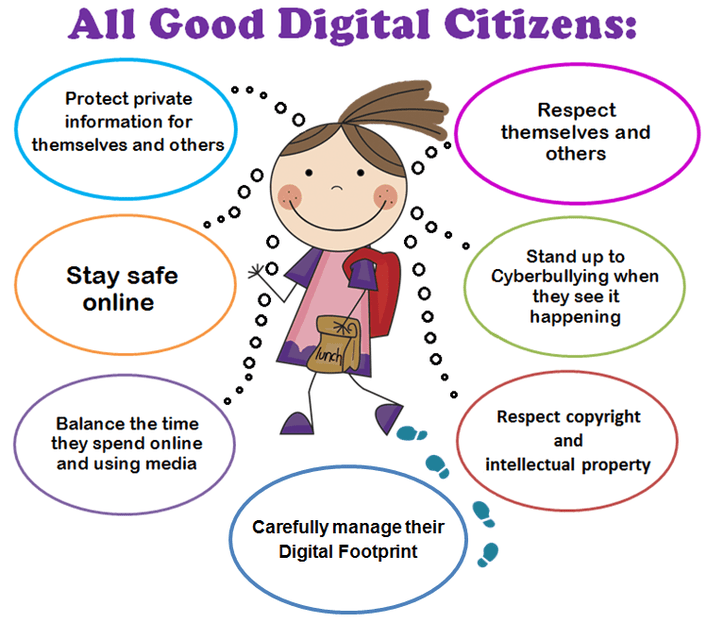
Good digital citizenship relates to family profession because it intersects with helping family on the content and practice of family life. Any family profession creates a respectful form of relationship between the clients and the employee. In this case it is more understanding for a family profession to encourage their clients or students to become a good digital citizen. For example, my little sister is in third grade, she admires her teacher and would always talk about the things that she learned in class. If her teacher was to give a lesson about being a good digital citizen, then she is most likely to remember it and will implement them in her daily activities when she is on the computer or wants to download a new game. As Godfrey mentions this being taught in class can “empower students to use technology appropriately and to develop positive digital footprints online” (Sheninger, 2014; Godfrey, 2016, p. 22). Also by doing this she is reminding others about how to use technology and creating a safe space on the internet. The family professions are to give guidance to their clients and this could be beneficial for others that are not aware of keeping their personal information away from the internet. Lastly, this plays a role in helping families delegate their use of IT. 

We should care because without understanding how to be a good digital citizen can create a snowball effect of creating possible stress in the family. For example, a daughter could be complaining about her parents being mean for not letting her go out with her friends because she didn’t do her chores. This daughter could also be expressing things out of anger and could possibly reveal their personal life on the Internet which could create more problems in the family. According to researchers from their studies their sample size uses a good amount of technology such as “emails (100% in personal life; 64% in couple therapy); social media (87% in personal life, 18% in couple therapy); texting (96% in personal life; 51% in couple therapy); and video chatting or calling (87% in personal life; 25% in couple therapy)” (Piercy, Riger, Voskanova, Chang, Haugen, Sturdivant, 2015, p. 212). This shows that everyone is always using technology either for their personal life or for other reasons. There is a higher percentage for people to use technology for their personal life which means how much of their personal lives are being shared to the world? Therefore we should become more aware of being a good digital citizen.

References

Godfrey, R., V. (2016). Digital Citizenship: Paving the Way for Family and Consumer Sciences. Journal of Family & Consumer Sciences. Vol. 108, No. 2, 18-22. DOI: 10.14307

Piercy, F., P., Riger, D., Voskanova, C., Chang, W., Haugen, E., and Sturdivant, L. (2015). What Marriage and Family Therapists Tell Us about Improving Couple Relationships Through Technology. Improving Couple Relationships Through Technology. 207- 227.

Featured

Power shift in Technology

I have seen a shift in the balance of power happening in my family. My dad has a little knowledge on technology since he used to fix computers however, my mom does not. The closest that she has ever used for technology is her phone by texting or calling me. This reminds me of Anderson’s statement that “(49%) of parents say they most often will use text messaging when they need to get in touch with their child quickly, while 41% most often call their child on the phone” (16). This actually happened a couple times when I was in high school, my mom was downstairs and the kids were upstairs. My mom couldn’t yell loud enough for my siblings to hear her, so she texted me first and then called all of my siblings to see if someone would answer the phone to grab her a blanket. But yes, this is one of the normal balance of parent-child relationship. However that shift has changed once all of my siblings and I went to college. 

My mom left her old work that did not require technology or using emails on the daily. Now her new job has made her realize that she needs to learn more about technology. I had recently helped her create an email and teach her how to access her email on phone and computer. This experience took me by surprise since I became frustrated with my mom since I had to try to break-down the things that I found simple and having to translate all of that in Hmong was a mess but we did it. As stressful as it was, it was interesting for me to see how much of a balance in power this was for me since my mom is someone in my culture that I had to listen to for advice and guidance but now I’m the one that is leading her on how to use an email. At one point my little sister that is eight-years-old was trying to teach my mom how to use the iPad to login to her email. This made me think of Anderson’s point about parents being “45 and older” (8) and allowing their children to use their digital devices for a longer period of time. I noticed that with my younger sister, she is surrounded by electronics and my parents are okay with it, however they were really strict with me using the computer to talk to my friends online. 

This reminded me of  I noticed that this made my dad feel uncomfortable since he was not there with me while I was re-teaching my mom the basic steps to creating and accessing her email. He was so used to being the man of the house and being the person that people call on for help when the internet is down or when my computer is broken. Now he is living like a free man that has no worries about teaching his kids and goes on Facebook more than me to find videos or memes. I sometimes catch myself trying to restrict my dad from using his Facebook account when I need to talk to him about something serious and he gets distracted. Then it makes me think of being a part of the 65% reports that punishes their teens by taking away their phones (Anderson, 2016). The balance of power in parent-child relationships has changed in my family but only due to technology there is a power change.I think that families should embrace the power shift at a certain point, because sometimes parents are afraid to admit that they need help.

References

Anderson, M. (2016, January 7). “Parents, Teens and Digital Monitoring”. Pew Research Center 

Featured

Response to Social Media Scandal Podcast

Before I listened to the podcast You can’t hit unsend: How a Social Media Scandal Unfolded at Harvard, my feelings were plateau. The tittle mentioned unsend, which sounds to me like another story about someone accidentally sending the wrong email. It didn’t seem like a big problem since most people know that they cannot hit unsend once an email has been sent. But I was completely wrong, it meant so much more than just a simple email being sent to the wrong person since this had affected this boy’s life and future.

This podcast had intersectionality on social media, race, disability, and historical trauma. It touched on every topic that was close to home that I just have to respond. I had to take a day to think this over and reanalyze the information that was given to me. I want to understand why he did such a thing. The podcast was about a high school boy being in small private group chat that shared offensive memes about disability, race, historical trauma and more controversial topics. The rules of being in the private chat was that in order for someone to be a member, they would have to send an offensive meme to another sub-group chat in order for them to be a part of the private chat. The boy continued doing this since he felt that it was funny, which made me thought of Turkle’s (2015) research of students not feeling empathy when they are communicating through a screen versus in person. Turkle (2015) mentions that people “understand each other less” (4) when they are touching their phone or are paying more attention to their electronics than the person. I can’t help but agree with Turkle, that none of them thought from the first offensive meme that it was hurtful and then someone decided to create another exclusive group chat. According to Lanigan (2009) “Americans spend an average of 15.3 hours online” (588). That means there are less physical interaction with people since they are always using their phone. This could explain why non of the members in the group chat seem to find the offensive memes to be disturbing or harmful. This group chat was then discovered by Harvard University and his acceptance letter along with his scholarship was declined.

In this generation, technology is expanding and almost everyone needs some type of technology that helps them function for the day. For example, my internet was down for a week and I could not get anything done other than using my phone with unlimited data. I also noticed that it went from having access to my personal items to me studying at a public library and even with a small change like that I wasn’t comfortable to use my social media accounts at a public library. It felt like my privacy was no longer private once I stepped out. According to Lanigan’s (2009) research “61.8% of American households owns computers, and 86.7% of those households access the Internet” (588). There is a bigger number of people having access to the internet than people owning a laptop. This is a little scary, and it makes me think of the privacy that people don’t have from having access to the internet and posting things on social media. It also made me thought of how Harvard could possibly find this private group chat and thinking back to his story. They had to post it onto another chat and that is where the privacy of the chat ended. I’m assuming that some people saw it and thought it was offensive and sent it to someone, and assuming that it was sent on their profile name shows that this person purposely sent the offensive memes.

Although, I do not condone his behavior I feel that he was not treated fairly. I still feel uncomfortable by his actions and response to the offensive memes but I don’t think he should be punished from something that he did in high school. This also made me question why some people on campus wouldn’t get kicked out if they had a scandal but they were suspended or given a punishment of writing an apology letter. As Turkle (2015) mentions “there is the magic of the always available elsewhere” (2) and it is the attention that makes it comforting for people to want to respond to the group chat. I also understand that this was done in “private” which means that they did not want to share these meme’s with the larger social media platform. This is coming from a group of teenagers in high school that wanted to make connections with friends and felt like he had done it through sharing offensive memes. Therefore I felt like he was being treated unfairly by the universities since almost all of the colleges had rejected his application.

References

Lanigan, J., D., (2009, October 21). “Marriage and Family Review.” Taylor & Francis Group. DOI: 10.1080

Turkle, S. (2015, September 26). “Stop googling. Let’s talk.” New York Times.

Vedantam, S., Schmidt, J., Kwerel, K., Boyle, T., Cohen, R., & Arablouei, R.  (2019, September 9). “You Can’t Hit Unsend: How a Social Media Scandal Unfolded at Harvard ” National Public Radio.

Applied post #2

If I was to lead a workshop on campus I would emphasize the importance of communication and intersectionality that could create conflicts in relationships. This particular one I would like to emphasize on having teens to participate since dating in high school is pretty dramatic. The icebreaker will be Fear in a hat. Everyone gets one piece of paper and write their own fears onto the paper then places it onto the hat. I will ask for volunteers to read some of the fears in the hat out loud if there are none then I will read a couple of them depending on how big the group is. As the fears are being read out loud people will step out of the circle if they feel that this fear relates to them or have ever thought about it. In the end of the section we will see how far and close they are from their partners which shows that their fears are going to affect them if they do not communicate this. I will ask the group what did they notice? Were you surprised by the outcome? Or what surprised you? How can we face these fears?

tumblr_o30jm05Ozp1sjwwzso1_540

The purpose of this activity is that I want people to visually see that by not communicating their concerns could create conflict and make them drift apart. Especially on the topic about social media uses and how that affects the relationship. As silly as it sounds to have conflict about social media usage there are conflicts when a girlfriend finds out their boyfriend liked some girls picture on Instagram or Facebook. According to Teen Voices in the Digital age “47% have expressed their attraction by liking, commenting or otherwise interacting with that person on social media”(2015) therefore it makes perfect sense as to why their partner is angry at them. This also adds on why their partner’s or significant other does not answer their phone but has time to like a girl’s picture. There is “85% of teen daters expected to hear from their significant other at least once a day, and 11% expect to hear from them hourly” (2015). I think the purpose of this is to feel secure in the relationship and knowing that its not one-sided. Nobody likes conflict in person or through technology.

A couple of solutions that I came up with are to communicate with your partner about their use of social media or if they even use it at all. Second, I think that people should limit themselves from using too much social media and updating people on their life. According to Pews Research Center, “teens who have access to mobile technology are more likely to be involved in conflicts that originate online or in text messages”. I also find this to be true for when friends argue through text or if there was misinterpretation about what someone has said which could escalate to bigger conflicts. Therefore setting boundaries from using your phone and understanding one another is a good way to avoid conflicts.


References

Teen Voices: Dating in the Digital Age. Pew Research Center. (2015, October 01). Retrieved from http://www.pewinternet.org/online-romance/

Lenhart, A. (2015, August 06). Chapter: Conflict, Friendships and Technology. Pew Research Center.

Finding Love Online or Offline


For a long time I was against finding love online because it didn’t make sense to me that two people could have a real connection using dating apps or social media accounts. The only couples that I knew about were from my parents and grandparents. My parents met in person and it was my dad that made the effort to visit my mom everyday. They also didn’t have technology in Laos and so if men saw a women that they were interested in they would approach them by asking if they can be friends. This gives men and women an opportunity to test their friendship and see if they really like each other.  My family found love by meeting their significant other in person and are living a happy marriage. Therefore when I heard about online dating or dating apps its just so odd to me that people meet online, fall in love and get married. The process of being in a relationship online sounds so fast that its unbelievable for me.

tumblr_nzufmtD8PO1shyusgo2_250

According to one of the Tedtalk, The Beautiful Truth about Online Dating it was interesting to hear from the speaker say that the big difference about getting people to want to talk to you or to swipe right (interest) is how they present themselves on their profile. For example, one person could be very vague about their description by having short answers such as being identified as shy, simple, fun or outgoing. It doesn’t have to be these exact words but having a vague description on their profile makes viewers not want to initiate a conversation compared to someone that says something along the lines of  “I am quite shy and slow witted in the beginning but ramp up as I get to know the person, a professional who strives to better oneself, and believes life should be enjoyed with fun and laughter”. She mentioned that this gives a better image of the person’s character compared to having short simple answers or statements.

Since I still had my own bias that dating apps is not where you find love I decided to test this theory out by signing up on OkCupid. For the first week I made my profile really plain like the one mentioned in Tedtalk. I also didn’t want to share too much about myself because it was awkward. It felt like I was trying to date my phone but I did my experiment anyway. Then the 2nd week I got more descriptive and mentioned more about the things that I look forward to in a relationship and the goals that I have for myself in the long-run. This experiment made me questioned myself multiple times like what is the point of being description about myself if we were going to get to know each other anyway? Or do I really need to describe myself to these people? and Was this just a bad idea? 

FlynRidder

As pointless as was for me to give a brief description of myself I did notice the difference between how people would interact with me. From my first week experiment there were people that showed interest in me and majority of men that were interested in my would tried to message me with a simple “Hi” or nothing at all. I also notice that there were more misunderstandings of my action. For example, if I was responding back to them, they would considered me to be officially dating them or that I had to be fully committed to this conversation. I literally talked to this guy for thirty minutes with basic conversation like “Hi, how are you doing?” and he was ready to be in a committed relationship. Which reminds of the article What Makes us Click: How Online Dating Shapes Our Relationships, that people “de-emphasis the importance of building a relationship”. Throughout my experiment I did felt that I was not able to build a relationship since the conversation was not genuine. This explains a little reason why I prefer getting to know someone face-to-face other than through apps. The online dating apps made me feel like people were more focused on shopping for the perfect personality that matches them. Which isn’t a bad thing, its just not for me.  Compared to my 2nd week there were more people that showed interest and responded more than a simple “Hi”. I also noticed that throughout my conversations on the 2nd week people were more descriptive and asked more creative questions compared to my 1st week. Instead of finding a romantic relationship on OkCupid I actually made new friends which is a type of relationship.

As against as I was about online dating I had a change of heart after my experiment since I was able to create some type of relationship through the online dating app. I am more opened to the idea that it could be possible for people to find love online. Since some of the process it takes to feel connected with someone sounds similar to finding love in person. For example, having to put yourself out there for people to want to introduce themselves or being shy about dating. Also, the more opportunities the better for people that wants to find love. However, it is still not for me

MonstersINC.gif


References

Roman, L., Brown, A., & Edes, A. (2018, January 02). What Makes Us Click: How Online Dating Shapes Our Relationships. Retrieved from https://www.npr.org/2018/01/02/572259115/what-makes-us-click-how-online-dating-shapes-our-relationships

TEDxTalks. “The Beautiful Truth About Online Dating” Youtube, Youtube, 27 July 2015, https://www.youtube.com/watch?v=mRWPqwyukGY


Applied post 1

During my class debate I was on the pro side of allowing laptops to be used in classrooms for taking notes. This was extremely difficult for me to argue for since I was actually against it. I remember the first time I hated taking notes on laptop was when I transferred to the University of Minnesota Twin Cities. It happened right after everyone was almost done taking an exam that a student decided to take out their laptop to work on an assignment. Honestly, I didn’t care if they needed to use their laptop, what I care about are the loud noises that was coming from the laptop while I was taking a test. It was like this person was pounding on  their keyboards and purposely trying to make me fail the test. Mind I tell you I’m a slow test taker, therefore this bothered me very much as they kept typing away in a quiet room.

1500x1000_laptops

Anyway, as against as I was to be on the pro side, I did find myself to be changing my thoughts on people taking notes on the laptop. during the debate, my classmates mentioned that laptops was more convenient for people to carry and has a better way to organize files compared to writing them on a notebook and not being able to read their handwriting. There would be Powerpoints posted online and it would be much easier for me to take extra notes and examples on the powerpoint. Sometimes I would use it to copy a graph of the Bronfenbrenner  Ecological model onto my notes on Google document since it is a theory that is still new to me. This makes it efficient for me to review my notes that are organized and to have a visual interpretation on my notes instead of me trying to create a sloppy version of the graph.

I know I am not alone in this when I say I Google a handful of terms when my professor is asking me a question or to do an activity. There are some days that I am trying really hard to stay awake for class and it just doesn’t work so I sometimes rely on Google to help me process the information. For example, I literally forgot how to spell rely and I had to Google this before I wrote it. As a student I think it’s best to use a laptop when I know that there are tons of notes that I would have to take during lectures. Also don’t take your laptops out when people are still taking a test, especially if you are mad nervous about the assignment, you are probably (most likely) pounding on the keys.